Queer Places:
Marlborough College, Bath Rd, Marlborough SN8 1PA, United Kingdom
University of Oxford, Oxford, Oxfordshire OX1 3PA
36 Ashburnham Rd, London SW10 0PA, UK
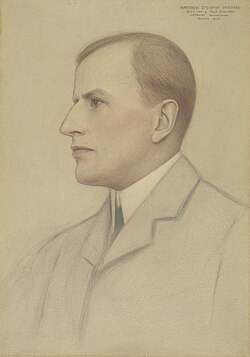 Matthew Stewart Prichard (January 4, 1865 – October 15, 1936) was born in Keynsham, England, to merchant Charles Henry Prichard and Mattie Stewart. After
attending Marlborough College in 1883, he graduated from New College, Oxford, in 1887 with a law degree and briefly practiced law in London. In 1892, he
came under the spell of a group of predominantly homosexual, Oxford-educated esthetes living at Lewes House in Sussex, centered around wealthy Bostonian
Edward Perry "Ned" Warren and his partner John Marshall. Warren
introduced Prichard to his brother, Samuel Dennis Warren, then president of the Museum of Fine Arts (MFA) in Boston. Samuel Warren brought Prichard to the
museum in 1902 as secretary to director Edward Robinson, intending for him to stymie Ned Warren's purchases.
Matthew Stewart Prichard (January 4, 1865 – October 15, 1936) was born in Keynsham, England, to merchant Charles Henry Prichard and Mattie Stewart. After
attending Marlborough College in 1883, he graduated from New College, Oxford, in 1887 with a law degree and briefly practiced law in London. In 1892, he
came under the spell of a group of predominantly homosexual, Oxford-educated esthetes living at Lewes House in Sussex, centered around wealthy Bostonian
Edward Perry "Ned" Warren and his partner John Marshall. Warren
introduced Prichard to his brother, Samuel Dennis Warren, then president of the Museum of Fine Arts (MFA) in Boston. Samuel Warren brought Prichard to the
museum in 1902 as secretary to director Edward Robinson, intending for him to stymie Ned Warren's purchases.
Prichard was quickly charmed by Ned Warren and traveled to Lewes, becoming an integral part of the household. Physically described as over six feet tall
with a spare athletic body, a long, rather cadaverous face, and long, thin, nervous hands, Prichard was an accomplished horse rider. He taught many of the
men at Lewes how to swim, where going into the water naked was de rigueur. Displaying eccentric intellectual habits, Prichard taught himself Turkish and
Arabic by memorizing words while shaving. In the streets of Lewes, he wore a Turkish fez, walked in the middle of the road with an abstracted air while
remaining impervious to local jeers, salaamed upon entering rooms, used Turkish and Arabic phrases for greetings and departures, and projected the
impression of having a private working relationship with Allah.
At the MFA, Prichard worked as a classical antiquities specialist and was promoted to assistant director by 1904. He also lived for a time in an
apartment at Isabella Stewart Gardner's Fenway Court, developing a close friendship with her and
heavily influencing her appreciation for contemporary art. However, Prichard developed a disdain for the artificial arrangement and display of objects in
museums and their appeal to the wealthy—views that ran counter to institutional norms. Through the MFA, he met Japanese curator Okakura Kakuzo, who
instilled in him an appreciation of oriental art, and British art historian Roger Fry, whom Prichard impressed in
1905 with his singular ideas on museology and oriental art. Conflict culminated when the board of trustees dismissed Prichard in 1907 for demanding the
removal of the museum’s plaster casts of classical sculpture.
Prichard relocated to Europe, discovering Byzantine art in Italy at San Marco and Ravenna—a genre he championed for the rest of his life. He settled in
Paris at the end of 1908, touring the Louvre with Fry and meeting art collectors Michael and Sarah Stein, who introduced him to Henri Matisse in 1909.
Prichard introduced Matisse to Byzantine art, becoming a devoted follower of the artist, who later created a drypoint portrait of Prichard in 1914.
Prichard also adopted the art philosophy of Henri Bergson as his personal aesthetic, disparaging Western art’s traditional verisimilitude in favor of
decoration. As an alluring and charismatic personality, he imparted his aesthetic to many, including nineteen-year-old Georges Duthuit (who became his
pre-war disciple and later married Matisse's daughter), Fry, and poet T.S. Eliot.
Prichard's life also intersected with significant personal pressures and social circles regarding his sexuality.
Sturgis Bigelow, an MFA trustee who had conspired with Sam Warren against Prichard, proposed exposing
Prichard as gay and investigated whether he was connected to the Oscar Wilde scandal. Later, while studying at the
Sorbonne in Paris, Prichard emerged as a luminary of Boston's homosexual community and a close mutual friend of
Jean Verdenal. Verdenal praised Prichard in letters for his "sincerity, his instinct for vital truths,
and his good sense," though he occasionally complained that their friendship was not progressing or seemed to take an "artificial" course regarding
morality.
In 1910, Prichard visited a seminal Islamic art exhibition in Munich, where he was joined by
Thomas Whittemore, who nursed Prichard through a long illness recovery in Paris that same year. Caught in
Germany when World War I broke out in 1914, Prichard was interned as an enemy citizen at the Ruhleben POW camp until the war's end, relying on food sent by
American friends. After returning to London in 1918, he developed a new coterie of followers at the Gargoyle Club, holding morning discourses on aesthetics
for figures like club owner David Tennant and future curator
John Pope-Hennessy, and organizing a conference at the Taylor Institution, Oxford, in 1919. In 1930,
Prichard financially supported and anonymously authored portions of Thomas Whittemore's first and second preliminary reports on the Byzantine mosaics
discovered at Hagia Sophia in Istanbul. Prichard died following a heart attack at his brother's home in Great Hampden, Buckinghamshire, on
October 15, 1936. Though his formal career as a professional art historian was brief, his spiritual and anti-materialistic approach to art and Byzantium
left an immense legacy on developers of the discipline.
References:
Other references:
- Prichard, Matthew Stewart. Current Theories of the Arrangement of Museums of Art.
- Prichard, Matthew Stewart. Greek and Byzantine Art (1921) – The published text of a conference given at the Taylor Institution, Oxford, in 1919.
- Whittemore, Thomas, et al. The Mosaics of St. Sophia at Istanbul: Preliminary Report on the Year's Work, 1931-1932: The Mosaics of the Narthex (Paris: Byzantine Institute of America, printed by J. Johnson at the Oxford University Press, 1933) – Features anonymous contributions and financial/editorial support from Prichard.
- Whittemore, Thomas, et al. The Mosaics of St. Sophia at Istanbul: Preliminary Report on the Year's Work: Second Preliminary Report, Work Done in 1933 and 1934: the Mosaics of the Southern Vestibule (1936) – Also featured anonymous support and portions written by Prichard.
- Isabella Stewart Gardner Museum Archives (Boston): Contains unpublished personal notebooks of Matthew Stewart Prichard, correspondence with Isabella Stewart Gardner, and object provenances (such as a gifted Egyptian XVIII Dynasty scarab).
- Bibliothèque Byzantine, Fonds Thomas Whittemore (Paris): Contains manuscript notebooks belonging to Matthew Stewart Prichard.
- Dictionary of Art Historians: Entry for "Prichard, Matthew Stewart" (compiled by Rémi Labrusse / database references).
- Oxford Dictionary of National Biography: Entry for "Prichard, Matthew Stewart" by Rémi Labrusse.
- Hadley, Rollin van N., ed. The Letters of Bernard Berenson and Isabella Stewart Gardner, 1887-1924, with Correspondence by Mary Berenson (Boston: Northeastern University Press, 1987).
- Sox, David. Bachelors of Art: Edward Perry Warren and the Lewes Brotherhood (London: Fourth Estate, 1991).
- Pope-Hennessy, John. Learning to Look (New York: Doubleday, 1991).
- Nelson, Robert. Hagia Sophia, 1850-1950: Holy Wisdom Modern Monument (Chicago: University of Chicago Press, 2004).
- Ketchum, John Davidson. Ruhleben: a Prison Camp Society (Toronto: University of Toronto Press, 1965).
- Whitehill, Walter Muir. "Some Correspondence of Matthew Stewart Prichard and Isabella Stewart Gardner," Fenway Court (1974).
- Haas, Karen E. "Henri Matisse: 'A Magnificent Draughtsman,'" Fenway Court (1985).
- Chong, Alan. "Mrs. Gardner's museum of myth," Res 52 (Autumn 2007).
Support this project
This website is a passion project researched, developed, and funded entirely by me. If you find the content valuable and would like to help support the ongoing research and hosting costs, any contribution is deeply appreciated.
Thank you for keeping this independent resource alive!
My books on Amazon: Elisa Rolle's books
BACK TO HOME PAGE